Switching and Recovery Guarantees for Hysteretic Model Selection under Monte Carlo Likelihood Refreshes
Preparing for submitting to IEEE Control Systems Letters, October 2026
Monte Carlo likelihood → Sample bank \((M,\ \chi)\) → Hysteretic selector \(\delta\) → Observer / controller
Redrawing Monte Carlo samples can switch the selected model even when the evidence moves slowly; reusing one bank stops this but can lock in a wrong decision. Sample size, refresh rate and margin must be designed together — and fewer switches can mean persistent wrong decisions.
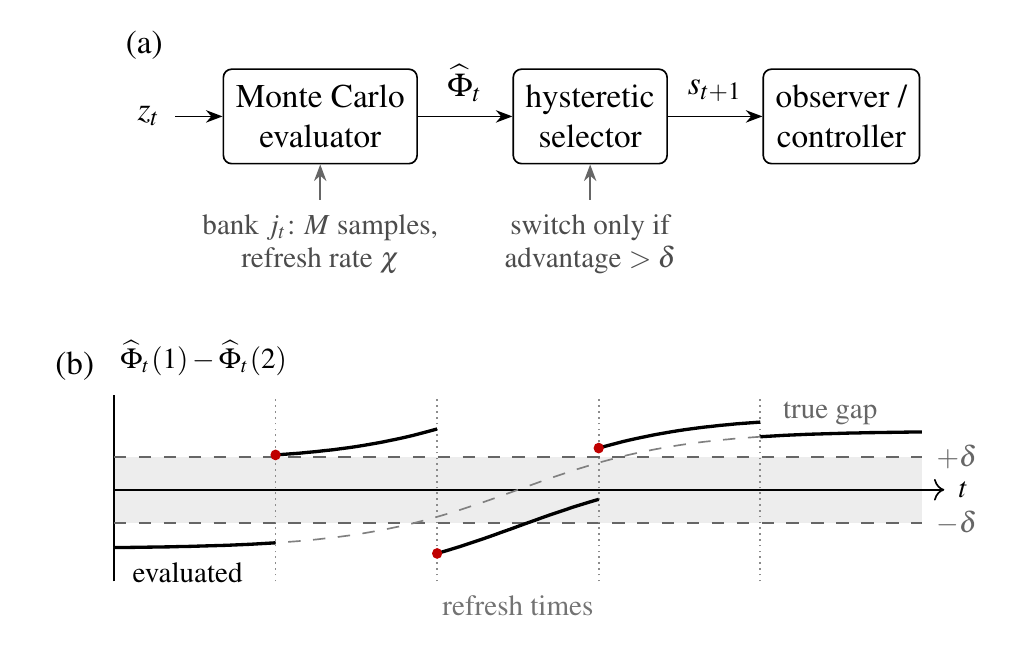 |
(a) Selection loop with design variables \(M,\ \chi,\ \delta\). (b) Schematic for two models: query motion moves the evaluated gap smoothly, refreshes make it jump, and crossing to the far side of the band \(\pm\delta\) is a switch. Refreshes alone cause a wrong switch and its reversal.
What Is the Problem?
A supervisor that selects one model from a finite dictionary must respond to regime changes while limiting reconfiguration. A hard selector is needed when one model drives a downstream action, such as gain scheduling, controller reconfiguration or allocating computation to a single filter. With Monte Carlo likelihoods, every refresh of the sample bank perturbs the evidence and can trigger switches by itself; reusing one bank removes this effect but can lock in a wrong decision.
Main Results
Recorded-score account (Theorems 1–2). On every path, switches are bounded by the initial potential plus the upward variation of the recorded scores, divided by the margin; an exact identity counts corrections. No accuracy certificate is needed.
Refresh-aware design (Theorem 3). Query motion and bank refreshes enter the switch budget separately, giving an explicit margin window that guarantees a prescribed switching density and immediate correction when the true score gap exceeds a threshold.
Uniform concentration (Lemma 2). Hoeffding bounds on likelihood ratios, uniform over a covering of the query region and valid for sample-dependent queries, turn the window into a sample size for continuous predictive laws with bounded kernels.
Observer consequence (Corollary 2). A selected-model observer inherits an average-dwell-time bound, conditional on the interval count.
Core Insight
Fewer switches can mean persistent wrong decisions. With four samples per reused bank, the exact failure probability per regime change is 5/16 = 31.25%, mostly from a hysteresis dead zone rather than rank reversal; the observed rate is 32.5 ± 1.7%.
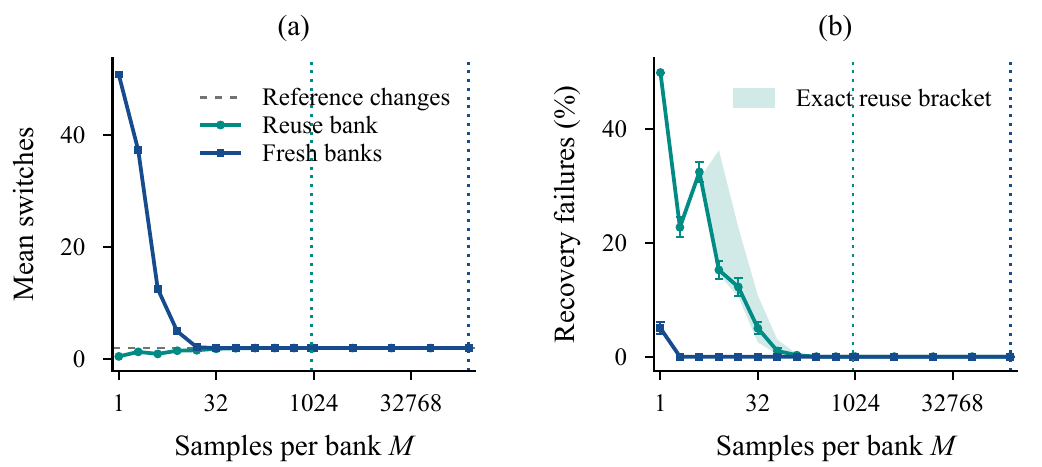 |
Finite-support design test, 200 paired query paths: (a) mean switches; (b) sustained-recovery failures with the exact reuse bracket (shaded). Dotted lines: certified budgets M = 945 (reuse) and 255,196 (fresh).
Numerical Studies
| Study | Scale | Finding |
| Finite-support design test | 200 paired query paths, 16 sample sizes, reuse vs fresh | Exact prediction of reuse failures at every sample size |
| Three-dimensional CV/CT tracking | 100 paired trajectories, K = 2 and 4, 10 selectors | IMM-MAP is a special case for K = 2; for K = 4 only its margin form recovers |
| Observer audit | 800 paths | Bound holds on every path; conservative |
Supplementary Video
35 s Julia-rendered replay of the three-dimensional tracking study and the finite-support design test.
Scope
The certificates are sufficient, not necessary, and hold on a high-probability accuracy event. The Gaussian tracking study measures the conservatism of the recorded-score accounts; Lemma 2 is not evaluated for that tracker.
Reproducibility
Code and data (zip, 5.7 MB): Julia 1.12.1 with pinned environments (CairoMakie 0.15.13, Distributions 0.25.129), predeclared seeds, test suites, archived score streams and all result files, with a README mapping every figure and table to its script.
The cached audit reproduces Table I from the archived Monte Carlo score streams; removing the cache flag regenerates all streams.
Supplementary video: 35 s Julia-rendered replay of the tracking study and the design test (above; render script in the zip, videos/).