Neural Belief Corrections for MPC: Plan-Consistent Scalar Budgets versus Myopic Directional Constraints
Technical Note submitted to IEEE Transactions on Automatic Control, October 2026
Reference belief \(\mathfrak{B}_{r,t}\) → Neural proposal \((m,P)\) → Budgets \(\delta_E,\ \varepsilon_B\) → MPC cell \(\mathcal{C}\) → Input tolerances \(\bar u_c,\ \bar u_a\)
The controller's input tolerances fix how far a neural observer may move its belief. A single scalar budget keeps the whole predicted input plan within tolerance; constraining only the applied input admits corrections that later inputs amplify — and in closed loop, plan consistency is still not safety.
TAC_TN_Supplementary_Video_S1.mp4 (94 s)
Supplementary document (7 pages):
NeuralBeliefMPC_supplement.pdf
Julia source code and data:
-
NeuralBeliefMPC_code.zip— Julia code with pinned environments and trained checkpoints, Python analysis scripts, packed replay contexts, every pooled context and closed-loop result, and the scripts of Figs. 2–3, with README (12 MB)
Neural Belief MPC asks a simple question about online-adapted neural observers: how far may the observer move its belief before the controller's input changes by more than a prescribed tolerance? We answer it with two certified belief budgets set directly from the input tolerances, and then show what happens when the simple scalar budget is replaced by sharper, controller-direction constraints.
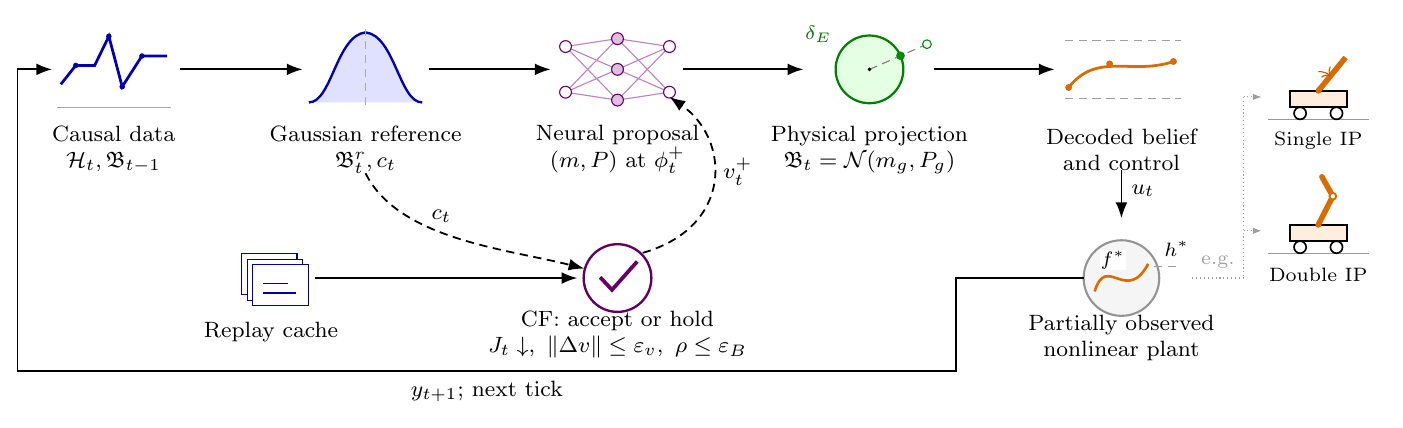
CF observer at one decision tick: the reference and the replay cache inform accept/hold; the projected belief feeds the controller.
What Is the Problem?
An online-adapted neural observer changes the belief from which a certainty-equivalent MPC computes its input in two distinct ways at every tick: the encoder corrects a reference belief, and accepted parameter updates move the belief computed from the same context. Prediction-score descent bounds neither change, whereas a control designer thinks in tolerances on input changes. The question is which belief budgets guarantee prescribed input tolerances — and how conservative the simplest such budget is.
Two Budgets and a Design Rule
- Every-correction budget (Theorem 1): each deployed correction obeys \(W_2(\mathfrak B_{g,x},\mathfrak B_{r,x})\le\delta_E\) with respect to its reference, including ticks without adaptation.
- Same-context update budget (Theorem 2): every accepted parameter update moves the belief computed from the same context by at most \(\varepsilon_B\) — a limit the correction budget alone cannot enforce.
- Controller-to-observer rule (Corollary 1): inside a known affine MPC cell \(\mathcal{C}\) with gain \(g_M=\|K_MS_x\|_2\), \[ \delta_E\le\min\{\delta_{\mathcal C}(\widehat x_r),\ \bar u_c/g_M\},\qquad \varepsilon_B\le\bar u_a/g_M \] keeps the current QP feasible and bounds correction- and adaptation-induced input changes by \(\bar u_c\) and \(\bar u_a\), without a true-state error bound.
Scalar Budget versus Directional Constraints
The scalar budget is a ball; the controller only "sees" the directions in the row space of its input map. Constraining those directions directly over the first \(N_h\) predicted inputs gives a larger set \(\mathcal{D}_B\supseteq\mathcal{S}_B\).
- Theorem 3 (Conservatism of the scalar budget): \(\mathcal S_B\subseteq\mathcal D_B\), with a nested-projection inequality; the extra corrections admitted by \(\mathcal D_B\) lie, up to an explicit margin, in \(\ker G_{N_h}\).
- Proposition 2 (Plan consistency and myopia): the scalar ball keeps all \(N\) predicted correction-induced inputs within \(\bar u_c\); with \(N_h=1\), later predicted inputs can be driven up to \(\gamma_k\sqrt{\tau^{\star2}-\delta_s^2}\), and under nominal propagation later applied inputs and states are amplified by explicit factors.
Core Insight
Admitting more belief motion in directions the current input does not see is not free: later inputs see it. Constraining the whole horizon restores plan consistency, but plan consistency is not safety — for this observer the scalar budget's conservatism is protective, and admitting more belief motion requires independent evidence that the proposal is accurate.
Simulation Study: Single and Double Inverted Pendulum
Do sharper, controller-aware belief constraints help a neural observer in closed loop with MPC?
Supplementary Video S1: Part 1 replays the saved Double-IP dropout run (seed 96301, 0.5× playback); Part 2 animates the closed-loop comparison after a last-pole mass change: the original map and the scalar budget stay within limits, whereas the directional variants violate them.
The plants are the official DeepMind Control Suite cart–pole and its two-pole generator, simulated in MuJoCo with RK4 at a 20 ms control tick. Positions and angles are measured with noise, velocities are hidden, and five profiles (nominal, last-pole mass +50%, angle bias, angle dropout, combined) are run with five seeds per plant. A horizon-50 constrained MPC uses the observer's belief.
| Study | Scale | Main finding |
|---|---|---|
| Frozen contexts, \(N_h=1\) | 4633 contexts from 50 replayed episodes | Later predicted inputs reach \(18.7\times\) the tolerance |
| Frozen contexts, \(N_h=N\) | same contexts | Plan within tolerance; Double-IP proposal distortion reduced by 9.6–30.5% (median); not more accurate against truth |
| Closed loop | 300 runs (2 plants × 25 episodes × 3 maps × 2 tolerances) | Directional variants yield 1–9 zero-violation Double-IP episodes of 25, against 16–17 for the scalar budget and 17 for the original observer |
Closed-loop Double IP, 25 episodes per entry, correction tolerance \(\bar u_c=0.001/0.01\) N:
| Deployed mean | Zero-violation episodes | Tracking RMSE [deg] | Plan change \(\max_k|G_kd|/\bar u_c\) |
|---|---|---|---|
| Original radial map | 17 / 17 | 0.89 / 0.89 | – |
| Scalar budget | 16 / 17 (15 of the original 17 retained) | 2.34 / 2.29 | 0.21 / 0.21 |
| Directional, \(N_h=1\) | 9 / 8 | 2.99 / 3.11 | 67.9 / 6.08 |
| Directional, \(N_h=N\) | 1 / 2 | 688 / 321 | 1.00 / 1.00 |
Tracking is the median over the 15 episodes with zero violations under both the original map and the scalar budget. In the Single IP all three maps keep 25/25 episodes free of violations with the original 0.34° median tracking.
Scope
The certificates hold in exact arithmetic under the stated covariance, domain and cell assumptions; they bound physical-marginal belief and input changes, not true-state estimation error. The trials establish neither an adaptation or covariance benefit nor nonlinear safety or recursive feasibility.
Reproducibility
All simulations, observers and MPC run in Julia 1.12.1 with pinned environments; post hoc projection studies and numerical primal–dual checks use Python (NumPy, CVXPY/Clarabel, SciPy). The 50 replays reproduce the archived test logs bit for bit.
-
NeuralBeliefMPC_code.zip—revision/julia/run_all.sh(replay and frozen-context extraction),revision/julia/closed_loop/(closed-loop deployment),revision/analysis/(pooled study, numerical primal–dual checks, Proposition 2 constants),revision/julia/single_figure/andrevision/julia/double_figure/(Figs. 2 and 3)
Raw per-tick records of all 600 pendulum episodes are available from the authors on request.