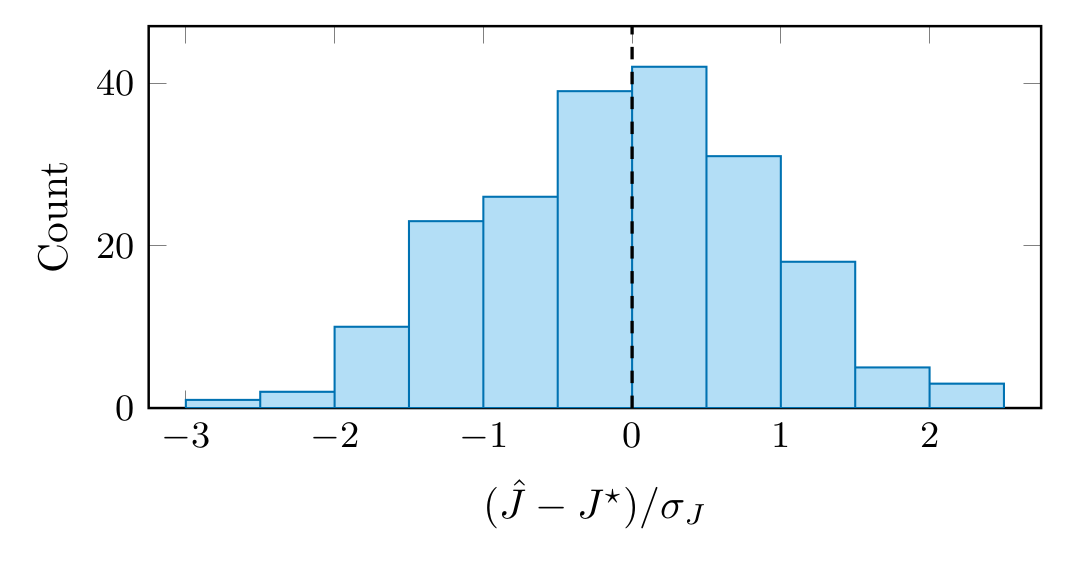
 (a) Estimator calibration
Bayesian MPC for Two-Qubit Bell-State Preparation under Decoherence and Exchange-Coupling Uncertainty
Preparing for IFAC Journal of Systems and Control, 2026
Journal extension of our IFAC World Congress 2026 paper on Bayesian MPC for quantum state regulation.
Highlights
Bayesian MPC prepares the Bell state |Φ+⟩ by a fixed deadline while learning an uncertain XY exchange coupling J from finite-shot computational-basis readout.
An exact Lindblad sensitivity bound links the posterior error about the true coupling to the excess cost of the Bayesian plan, with an explicit, horizon-linear constant.
In simulation, posterior updating drives the improvement over nominal MPC; certainty-equivalent MPC at the posterior mean performs comparably at less than half the runtime.
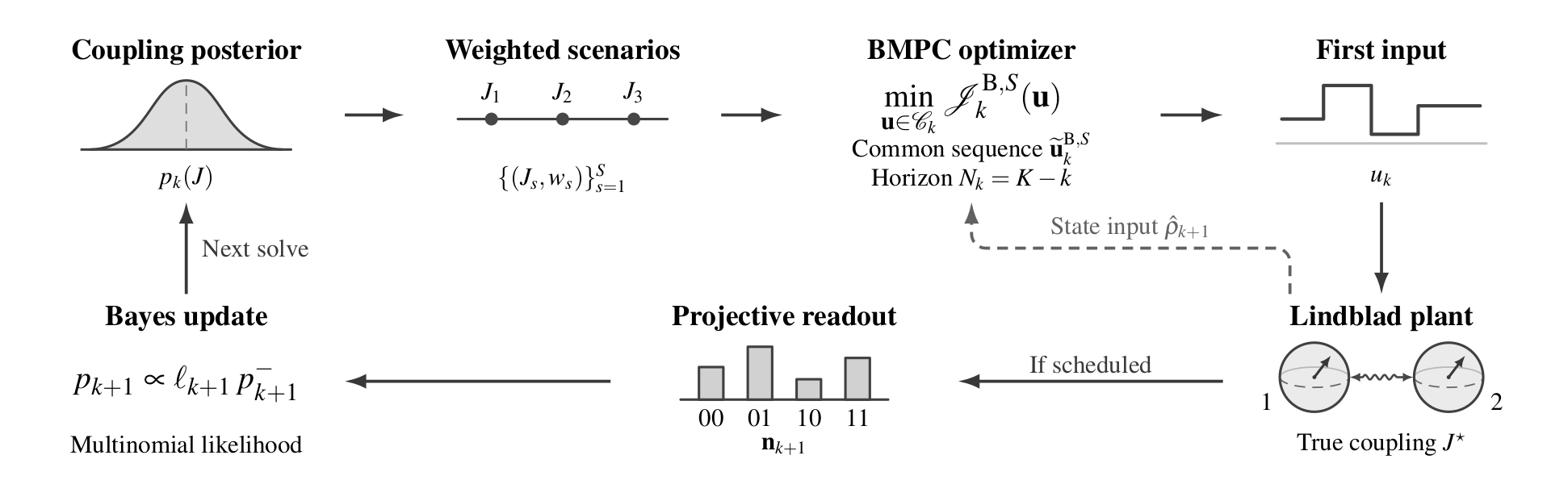
Closed-loop Bayesian MPC. Weighted posterior scenarios define one common control sequence whose first input is applied; scheduled computational-basis shots update the coupling posterior.
Abstract
We formulate Bayesian model predictive control (BMPC) for two-qubit Bell-state preparation by a fixed deadline under Lindblad decoherence and uncertain exchange coupling. Multinomial shot batches update the coupling posterior, and exact interval propagation predicts the response to one bounded control sequence. A trace-distance sensitivity bound limits the excess regularized cost of a globally optimal Bayesian plan relative to a globally optimal known-coupling plan at the same decision instant and state. Under local regularity assumptions, we bound the sequence gap to a local oracle solution, accounting for scenario compression and solver stationarity error. In 50 simulated trials at each of the −30% and +30% coupling mismatches, where terminal fidelities are about 0.88 and 0.78, the mean terminal fidelity gains over nominal MPC are 9.1×10⁻⁴ and 1.14×10⁻², or 27.8% and 45.1% of the gaps to a numerical oracle. Fixed-prior ensemble MPC recovers −7.0% and 3.9%, while certainty-equivalent MPC at the posterior mean recovers 32.7% and 42.8%. BMPC recovery is higher at a subsequent iteration cap of 16 than at 4 at both mismatches. In a separate fixed-state test, narrower constructed posteriors give smaller computed control gaps.
Problem
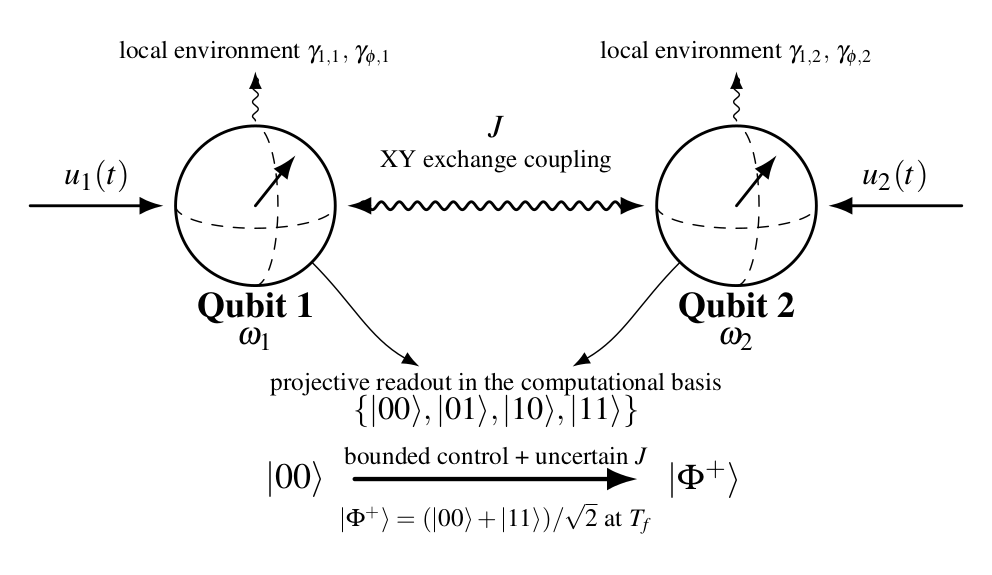
Two qubits with local drives u1, u2, uncertain XY exchange coupling J, local amplitude damping and dephasing, and computational-basis readout. The task is |00⟩ → |Φ+⟩ at the deadline Tf.
Theoretical contributions
Exact finite-time sensitivity. For any admissible control sequence, the terminal trace distance between couplings J and J′ is at most τk‖HJ‖∞|J − J′|, with ‖HJ‖∞ = 1 (Duhamel identity and trace-norm contractivity of CPTP maps).
Oracle-regret bound for globally optimal plans. The oracle cost of the Bayesian plan exceeds the oracle optimum by at most 2τk√εk, where εk is the posterior mean-square error about the true coupling. No convexity or uniqueness is needed, and posterior contraction is not assumed.
Local optimizer gap. Under local strong convexity, the distance between local Bayesian and oracle sequences is at most (Lg/σk)√εk.
Scenario compression and solver residual. Equal-mass conditional-mean scenarios satisfy an exact orthogonality decomposition, so the bounds hold with a sharper error term; a further term accounts for the stationarity residual of the computed sequence.
Key results
| Controller (50 trials per mismatch) | Recovery, −30% | Recovery, +30% |
|---|---|---|
| BMPC (3 posterior scenarios) | 27.8% | 45.1% |
| Fixed-prior ensemble MPC | −7.0% | 3.9% |
| Certainty-equivalent MPC (posterior mean) | 32.7% | 42.8% |
| BMPC, 16 iterations per solve | 43.4% | 53.1% |
Recovery is the fraction of the oracle–nominal terminal-fidelity gap closed by the controller. BMPC beats nominal MPC in 49/50 and 50/50 trials. The coupling estimator’s root-mean-square error (3.02×10⁻³) matches the Cramér–Rao bound of the readout protocol (3.21×10⁻³).
(a) Estimator calibration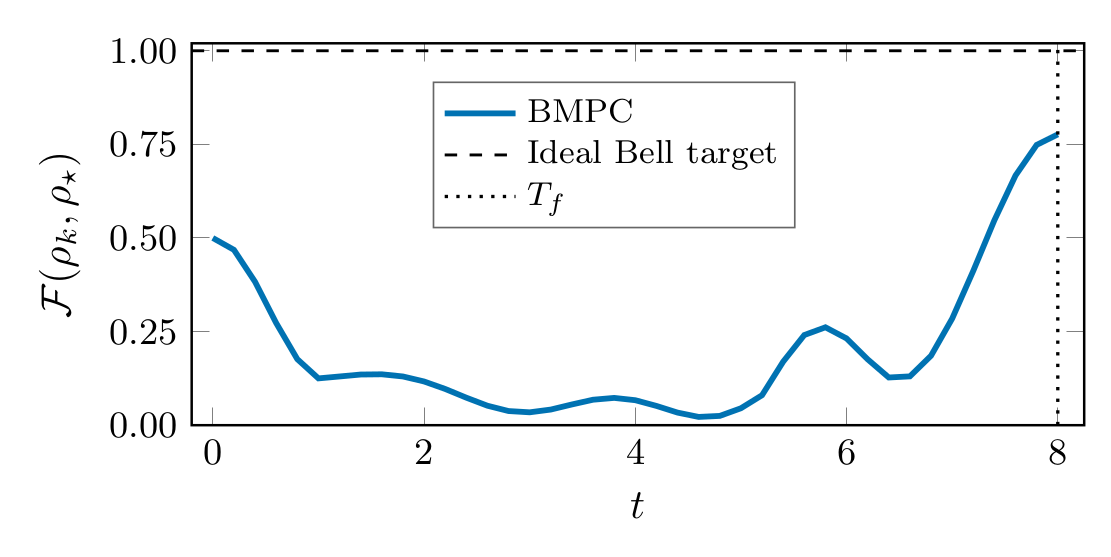 (b) Representative fidelity
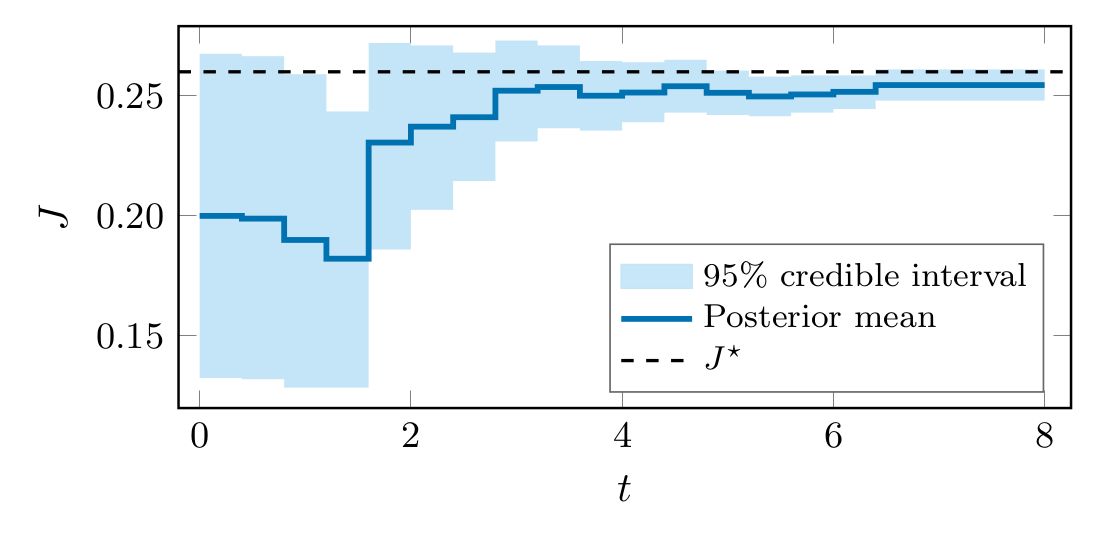 (c) Coupling posterior
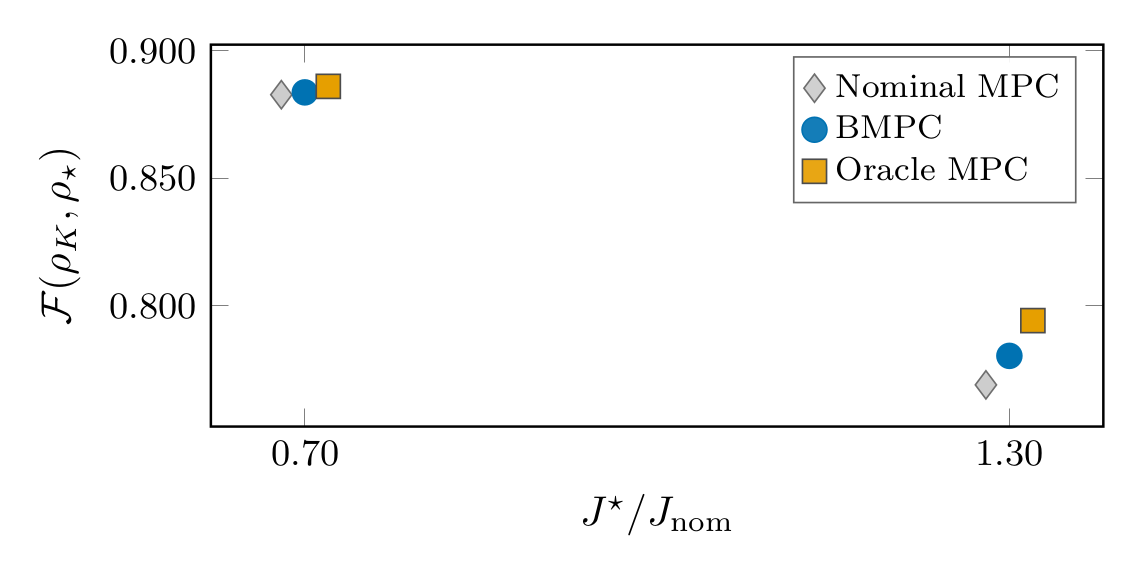 (d) Terminal fidelity
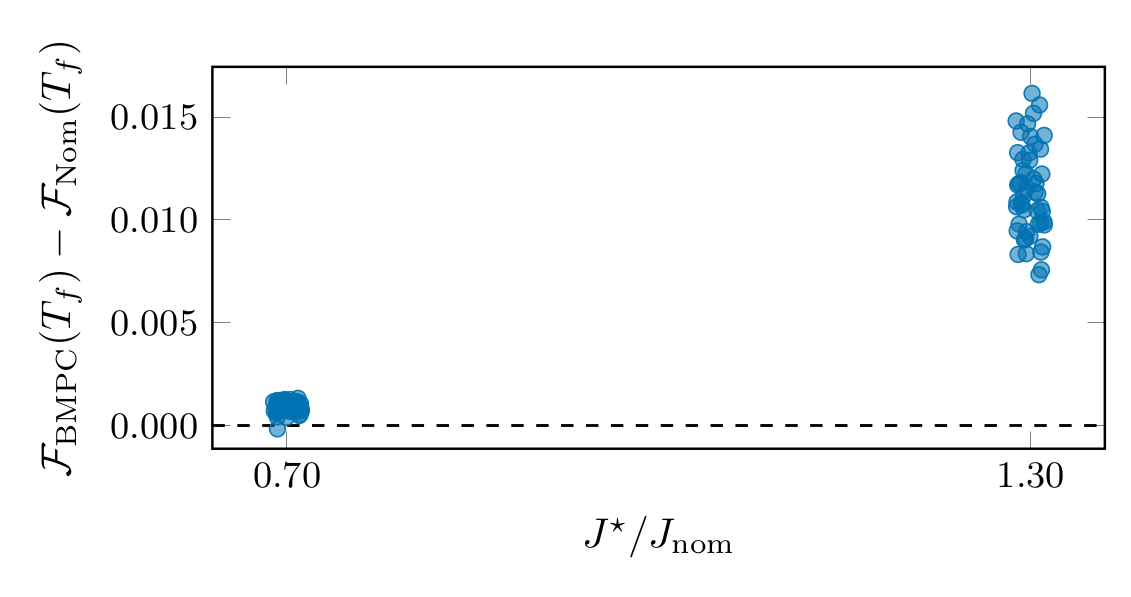 (e) Gain over nominal MPC
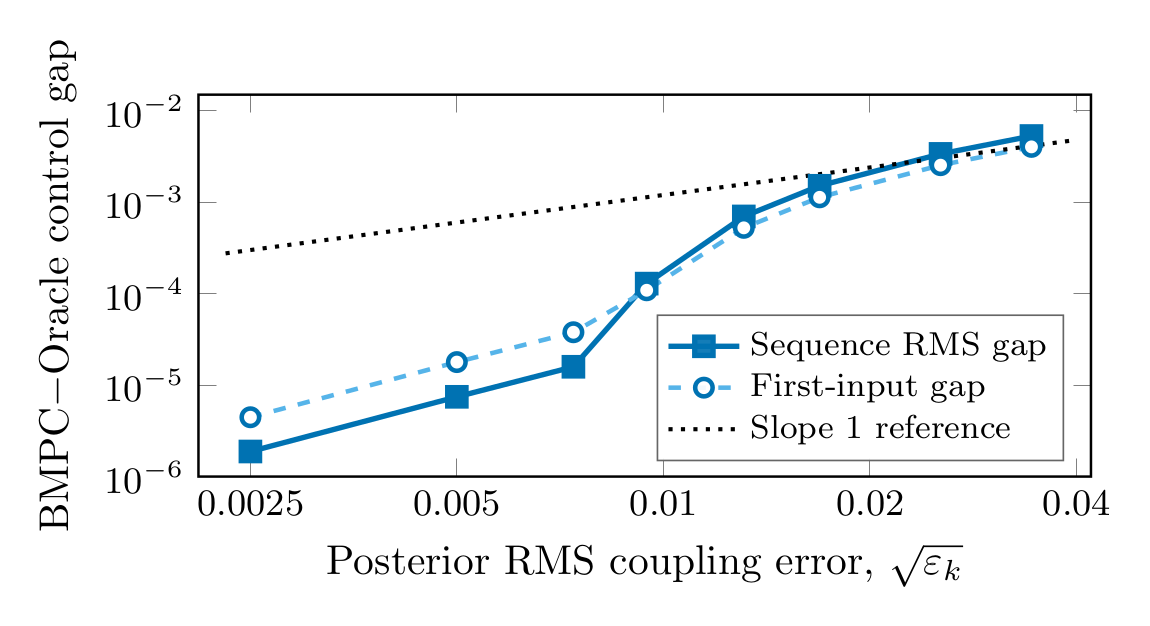 (f) Fixed-state control gap
Blue: BMPC; grey: nominal MPC; orange: oracle; black: true values and targets.
Code and data
The archive contains the complete Julia pipeline, the saved outputs behind every table and figure, and the script that draws the figures. One command reruns all experiments:
cd julia
julia --project=<environment> run_all_audit.jl ground
Random seeds: production benchmark 20260920, calibration 20260916, bootstrap 20260921. The included README maps each file to the paper.